Review · SYDNEY
Sydney: Whale Watching Adventure Cruise
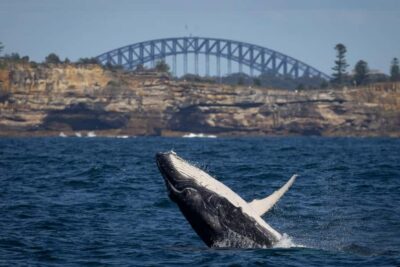
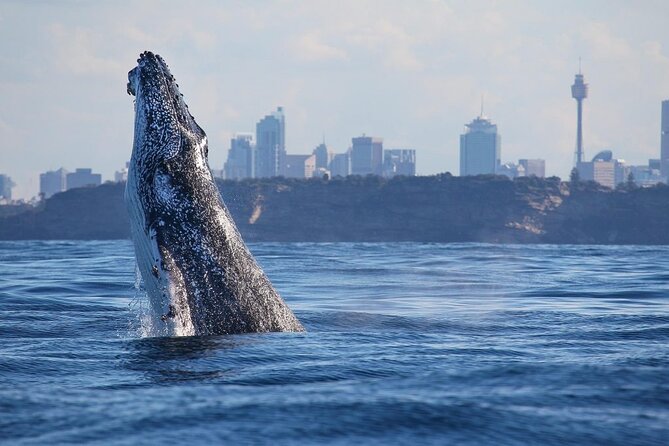
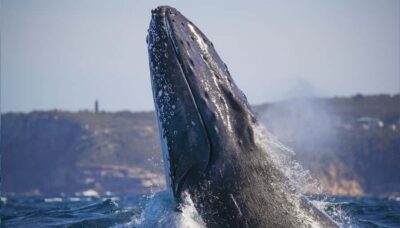
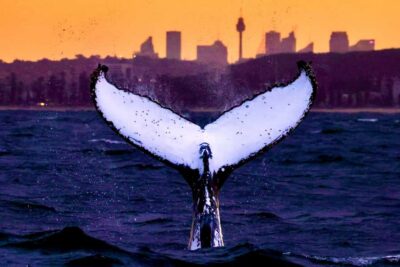
Sydney’s humpback whales are the real stars here, but the trip begins with a fine supporting act: Sydney Harbour from the water. You leave from Circular Quay, pass the Opera House and Harbour Bridge, then head toward the open Pacific in search of breaching whales, tail slaps, mothers with calves, and dolphins.
I like the 2-hour-45-minute running time, which gives the crew a fair chance to find wildlife rather than turning around after a quick look. I also like the respectful approach to the animals and the whale guarantee. The main caution is simple: this is an open-water cruise, and the boat can roll hard enough to make even seasoned sailors feel queasy.
- Whale sightings are guaranteed: If you see no whale, you receive a complimentary return trip valid for 12 months, subject to availability.
- Circular Quay departure: Check in at the Eastern Pontoon, between Ferry Wharf No. 2 and the Opera House.
- A proper open-water trip: Expect wave motion, wind, spray, and possible seasickness beyond the sheltered harbour.
- Comfortable viewing areas: The catamaran has spacious decks, seating, toilets, and a licensed bar.
- Helpful onboard commentary: Guides explain humpback behavior, migration, and the animals you are watching.
- Free hot drinks: Tea, coffee, and hot chocolate are served onboard, a welcome touch on cool or wet days.
From Circular Quay to the open Pacific
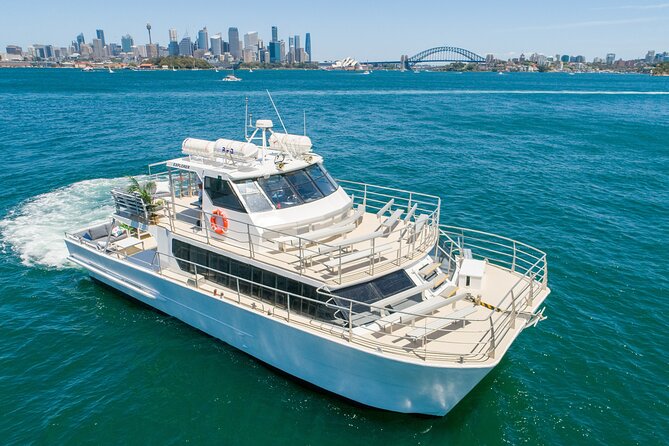
Your starting point is easy to find, but allow time. The check-in booth is at Circular Quay’s Eastern Pontoon, along the promenade between Ferry Wharf No. 2 and the Sydney Opera House. You need to arrive 30 minutes before departure. After that cutoff, the operator can resell your seat, and late arrivals do not receive a refund.
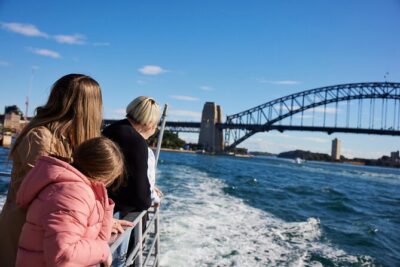
The first part of the cruise gives you some of Sydney’s best sightseeing without asking you to do anything except look up. The Harbour Bridge and Opera House appear from a low, shifting angle that you cannot get from the usual waterfront viewpoints. You may also see naval ships in dock as the boat heads out.
This harbour section is more than a warm-up. If the whales stay distant, or the sea becomes too rough for you to enjoy the search, the city views still give the trip a worthwhile beginning and end. Bring a camera, but keep it ready rather than glued to the screen. A whale can surface for only a few seconds.
The catamaran and where to sit
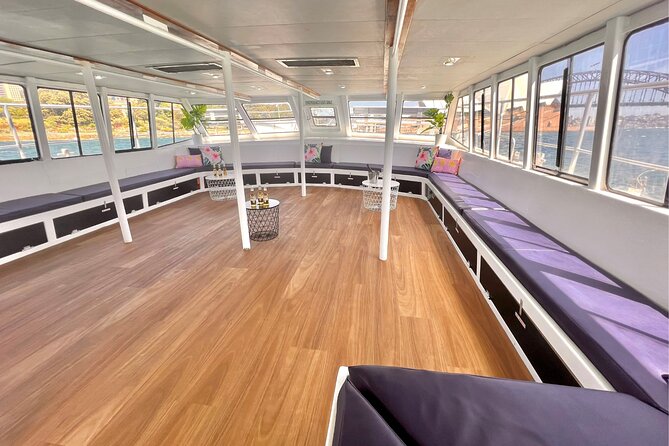
The vessel offers large outdoor decks, indoor seating, toilets, and a licensed bar. That mix matters because conditions can change quickly once you leave the harbour. You can begin outside for the best sightlines, move inside for shelter, or warm up with a hot drink during the return journey.
For the calmest ride, the back of the boat is a sensible choice. One particularly practical tip is to try the upper rear deck, where the motion may feel gentler and you are less likely to take spray over the bow. The front offers a dramatic view, but it is also more exposed to wind, water, and the boat’s movement.
If you want to hear the commentary clearly, do not automatically choose the very front outdoor seats. Engine noise can overpower the speakers there, and some areas near the bow make it hard to follow the guide. A position with a clear view and a speaker nearby may be a better compromise.
There is no bad seat in the sense that the catamaran has broad viewing areas, but whale watching is not a theater performance. You may need to turn, move, or scan a wide stretch of water. Stay flexible, and avoid blocking other people’s view when a whale surfaces.
More Whale Watching Cruises in Australia
- Sydney Whale-Watching Cruise Including Lunch or Breakfast
★ 4.5 · 878 reviews - Sydney: 2-hour Express Whale Watching Cruise
★ 4.2 · 756 reviews - Sydney Whale Watching Cruise with Breakfast or Lunch
★ 4.4 · 340 reviews
Allowing time for the whales
The listed duration is 165 minutes, or 2 hours and 45 minutes. That sounds generous because it is. The boat may spend around 40 minutes getting to the whale area and a similar amount returning, leaving a useful stretch of time for the search and sightings.
That travel time is part of the experience, not wasted time. Humpback whales are not waiting beside the harbour entrance. The crew needs to reach open water, check current conditions, watch for blows and movement, and respond to reports from passengers and other boats.
Some outings find whales quickly. Others require a long search. You might spend an hour seeing little, then suddenly find several whales moving through the same area. The crew may stay longer when conditions and sightings allow, but you should not treat any exact whale-watching schedule as fixed.
This is why the guarantee is valuable. If no whale appears, you receive a complimentary return cruise valid for 12 months, subject to availability. It is a fair response to the fact that wildlife does not follow a timetable. Contact the provider for the details and available dates before relying on the return option.
What a whale encounter is really like
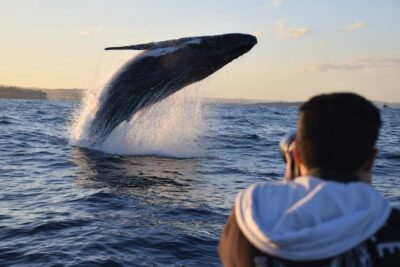
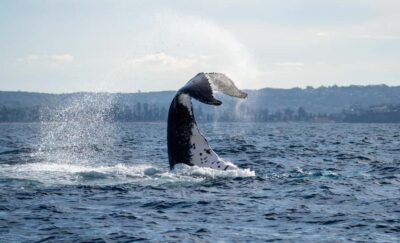
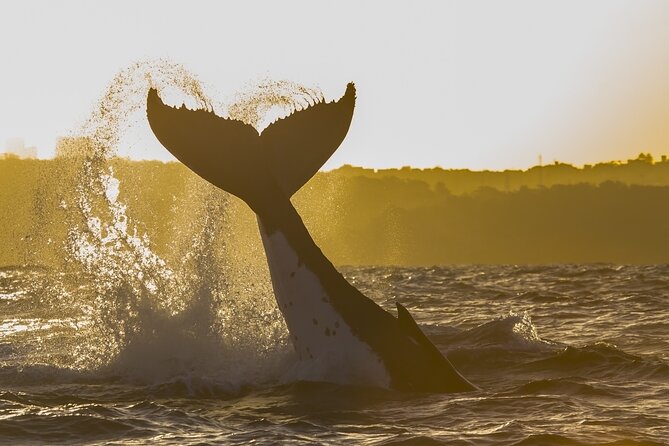
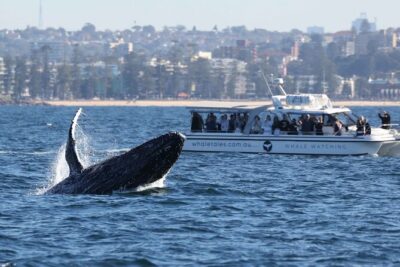
Expect a natural sighting, not a trained-animal show. A humpback might surface far away, show its back, lift its tail, or breach several times. A mother and calf may travel together. Dolphins can also appear, and some trips have produced several groups of whales or a pod moving close to the catamaran.
The crew’s job is to position the boat without disturbing the animals. That means the best encounter may still involve a respectful distance. You might see a whale clearly through binoculars but fail to capture a good photograph. That is normal. A phone camera can turn a visible whale into a tiny dot.
Bring binoculars if you have them. They are especially useful on days when the whales remain far from the boat. You should also keep your expectations realistic: close approaches and multiple breaches happen, but no responsible operator can promise those particular behaviors.
The most memorable sightings are often the simplest. A whale’s back arches, the tail rises, and the animal disappears. Then you wait. That pause is part of the appeal, though it can test the patience of young children and anyone expecting constant action.
Commentary that adds something to the trip
Live English commentary gives the search some shape. The guides explain humpback behavior and point out activity that you might otherwise miss. That is useful because whale watching involves a lot of scanning, and an experienced eye can spot a blow or fin before you do.
The commentary also helps you understand why the boat keeps changing direction or slowing down. You are not simply riding out to a fixed viewing point. The crew is reading the water and trying to locate animals while keeping a respectful distance.
Several outings have featured a marine biologist or a guide with strong marine knowledge. The useful part is not a flood of technical terms. It is learning to recognize what you are seeing, from a tail lift to a breach, and understanding how humpbacks behave in the waters off Sydney.
The engine can be loud, especially outside and toward the front. If learning the facts matters as much as seeing the whales, choose a seat near a speaker and move closer when the guide begins an important explanation. The bar and indoor cabin provide shelter, but sound may be less clear when the cabin is full.
More Whale Watching Cruises in Sydney:
- Sydney: Scenic Whale Watching Cruise – Whales Guaranteed
★ 4.6 · 318 reviews - Sydney: Whale Watching & Wildlife Cruise
★ 4.3 · 300 reviews - Sydney Whale Watching Cruise from Circular Quay
★ 4.5 · 207 reviews - Sydney Whale Watching – 2.5hr Discovery Cruise
★ 4.0 · 120 reviews
Sea conditions and seasickness
This is the practical issue to take seriously. The boat operates on open water, where conditions can be smooth one day and rough the next. Several accounts describe rolling and strong waves, with some people becoming sick even when they had never had motion sickness before.
Take an over-the-counter seasickness tablet before departure if you know you are prone to motion sickness or are unsure about your sea legs. Follow the product instructions, and speak with a health professional if needed. Waiting until you feel ill can be too late.
Eat sensibly beforehand, bring warm clothes, and dress for the weather rather than the temperature at Circular Quay. The harbour may feel mild while the open ocean is windy and cold. A waterproof layer is useful even when rain is not in the forecast.
The tour runs in all weather, including rain. If you would rather not go in poor conditions, contact the provider at least 24 hours ahead to request a reschedule. Do not assume that a rainy morning means the cruise is canceled.
A rough ride is not automatically a bad ride, but it changes the experience. You may spend less time taking photos and more time holding on. If motion sickness would ruin your day, check the forecast and consider choosing a calmer date when possible.
Is the $63 fare good value?
At $63 per person, this is a reasonably priced way to combine Sydney harbour views with a serious attempt at whale watching. You are paying for nearly three hours on the water, live commentary, a catamaran with outdoor viewing space, toilets, and free tea, coffee, and hot chocolate.
The value improves because the trip is not just a short harbor cruise. The boat reaches the open coast, where humpbacks are passing, and the crew gives the search enough time to produce multiple sightings when conditions cooperate. The return-trip guarantee also reduces the risk of paying for a wildlife trip and leaving with nothing but sea spray.
Still, the fare does not buy a private experience. You share the boat with other passengers, and a busy deck can make it harder to move from one viewing position to another. The engine may be loud, the sea may be rough, and the whales may stay far away.
I would call it good value for someone who wants both wildlife and scenery. If your main goal is a polished sightseeing cruise with calm water and a fixed schedule, this is less suitable. If you accept that nature sets the timetable, the price is fair.
Who should book this cruise

I would recommend it to first-time visitors who want to see Sydney from the harbour and have a genuine chance of seeing humpbacks. It also suits families with older children who can handle a long period outdoors and understand that wildlife sightings are not guaranteed at a precise time.
The trip is a good fit for photographers, but bring binoculars and do not expect every photo to be sharp. It also works well for anyone interested in marine life, since the commentary gives context rather than leaving you to guess what is happening.
I would think twice if you have serious mobility limitations, since the activity is not suitable for wheelchair users. I would also be careful if you are highly prone to seasickness, have little time in Sydney, or need a guaranteed calm ride.
The crew’s respectful behavior is important. The boat is there to observe, not chase or crowd the animals. That gives you a better kind of encounter, even when the whale remains a short distance away.
Booking details worth knowing
The tour is conducted in English and lasts 165 minutes. The operator offers free cancellation up to 24 hours before departure, and you can reserve now and pay later, which helps if your Sydney schedule is still shifting.
Check the available start time before booking, since the exact departure options can vary. Arrive 30 minutes early at the Eastern Pontoon. Wear warm, weather-appropriate clothing, and plan for the possibility of rain.
If no whale is spotted, ask about the complimentary return trip before leaving. It is valid for 12 months, but availability applies. If you are departing Australia soon, confirm how the operator handles the alternative, since the return option may not fit your schedule.
Should you book it?
Yes, if you want a fairly priced open-water adventure with a strong chance of seeing humpbacks and a useful fallback if nature refuses to cooperate. The best parts are the long viewing time, respectful wildlife approach, good harbour scenery, and guides who help you understand what you are seeing.
Book with sensible expectations. Bring binoculars, dress warmly, take seasickness precautions, and choose a rear or upper-deck position if the sea is unsettled. If you can accept a rolling boat and a whale that may surface far away, this is a worthwhile Sydney outing.
FAQ
Where does the whale-watching cruise leave from?
Meet at Circular Quay’s Eastern Pontoon. The check-in booth is on the promenade walkway halfway between Ferry Wharf No. 2 and the Sydney Opera House.
How long does the cruise last?
The cruise lasts 165 minutes, or 2 hours and 45 minutes.
What happens if no whale is seen?
The operator offers a complimentary return cruise valid for 12 months if no whale is spotted. The return trip is subject to availability, so contact the provider for details.
Does the cruise operate in bad weather?
Yes. The tour operates in all weather conditions, including rain. If you want to reschedule because of the weather, contact the provider at least 24 hours in advance.
What should I bring?
Bring warm clothing and weather-appropriate clothing. If you may suffer from motion sickness, consider an over-the-counter seasickness tablet before departure and follow the instructions.
Is the cruise suitable for wheelchair users?
No. The activity is not suitable for wheelchair users.
Newly added whale trips around Sydney
- Whales of Sydney Sea Safari★ 5.0 · 2 reviews
- Sydney Whale Watching Cruise from Circular Quay★ 4.5 · 207 reviews
- Whale Watching Sailing Experience in Sydney★ 5.0 · 28 reviews
- Sydney Harbour Tall Ship Whale & Sail – Whale Watching Cruise★ 5.0 · 5 reviews
- Sydney Whale Watching on Small RIB★ 5.0 · 14 reviews
- Whale Watching on Speed Boat with canopy from Sydney Harbour★ 5.0 · 14 reviews
- Whale Watching Sydney★ 3.5 · 17 reviews
- Whale Watching & Hop On Hop Off Sydney Harbour Explorer Cruise★ 4.0 · 2 reviews
Sydney Whale Watching Tours, side by side.
Sydney Whale-Watching Cruise Including Lunch or Breakfast
Read our review →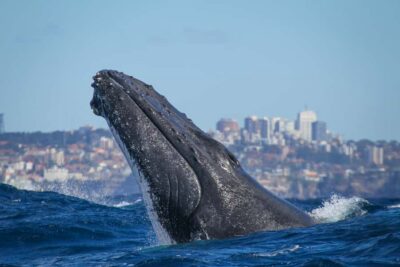
Scenic Whale Watching Cruise – Whales Guaranteed
Read our review →