
Review · TYRRHENIAN SEA, ITALY
Genoa: Pelagos Sanctuary Whale Watching Cruise
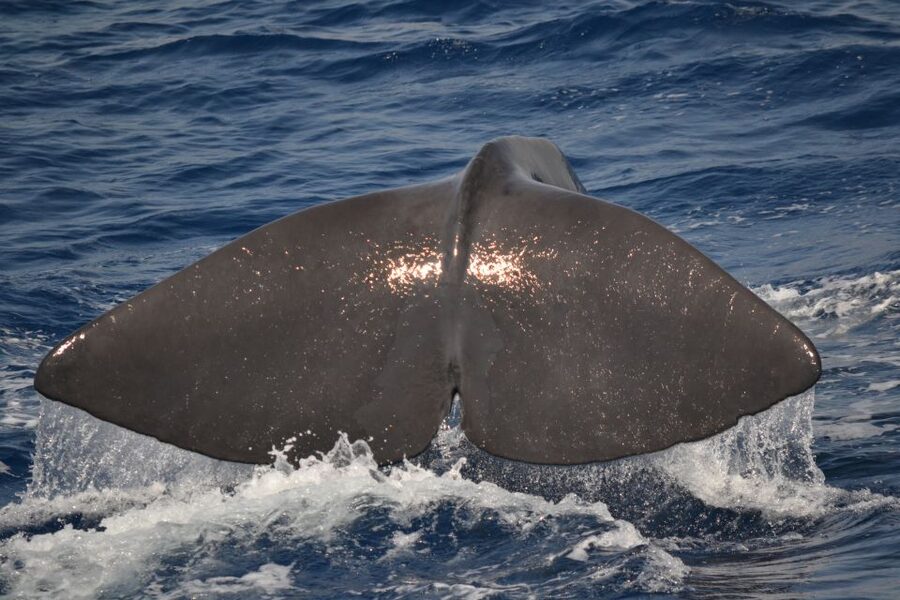
The best part of this four-hour cruise is the search itself. You leave Genoa’s harbor, reach the deep Pelagos Sanctuary, and watch a crew of spotters patiently scan the sea for wild animals. Striped dolphins, sperm whales, fin whales, and Cuvier’s beaked whales have all appeared on recent trips, along with turtles and seabirds.
I like the biologist-led commentary and the respectful approach to wildlife. I also like the price, about $51 per person, which is fair for four hours on the water. The main drawback is simple: sightings are never promised, and calm seas matter a lot. You may spend long stretches watching empty water before the next blow or fin appears.
Key points
- Deep-water search area: After about 30 minutes, the boat reaches water roughly 1,000 to 1,500 meters deep, where larger cetaceans are more likely.
- Wildlife varies: You could see striped dolphins, sperm whales, pilot whales, fin whales, beaked whales, turtles, and seabirds.
- Patient crew: Several spotters use binoculars and keep watch throughout the search.
- Best conditions: Calm seas and little wind make animals easier to see when they surface.
- Seasonal schedule: Trips run from April through October, with departures at 1 p.m.
- Second chance: If nothing at all is seen, you can return once for free within one year.
From Porto Antico to the Pelagos Sanctuary
Your meeting point is Calata Mandraccio in Genoa’s Porto Antico, near the Bigo and the Genoa Coast Guard patrol boats. This is a convenient spot in the old harbor, but give yourself time to find the exact pier. The boat leaves at 1 p.m.
The first half hour is spent getting away from the port and toward open water. This stretch gives you a changing view of Genoa from the sea, then the city gradually drops behind as the boat reaches the deeper part of the sanctuary.
The important change is not a marked boundary or a dramatic stop. It is the depth. The cruise aims for water between about 1,000 and 1,500 meters deep, where sperm whales, beaked whales, and other cetaceans can pass through. Once the boat reaches this area, the crew begins a careful search rather than following a fixed route to a guaranteed viewing point.
That distinction matters. This is not an aquarium visit or a short boat ride built around a scheduled animal appearance. You are looking for free-ranging wildlife in a large area of sea. The route and timing depend on what the spotters see.
More Whale Watching Cruises in the world:
- Reykjavík: Whale Watching and Marine Life Cruise
★ 4.6 · 9,838 reviews - Funchal: Dolphin and Whale Watching Catamaran Cruise
★ 4.5 · 5,697 reviews - Costa Adeje: Whale & Dolphin Eco-Cruise with Snacks & Drinks
★ 4.6 · 5,096 reviews
How the four-hour search unfolds
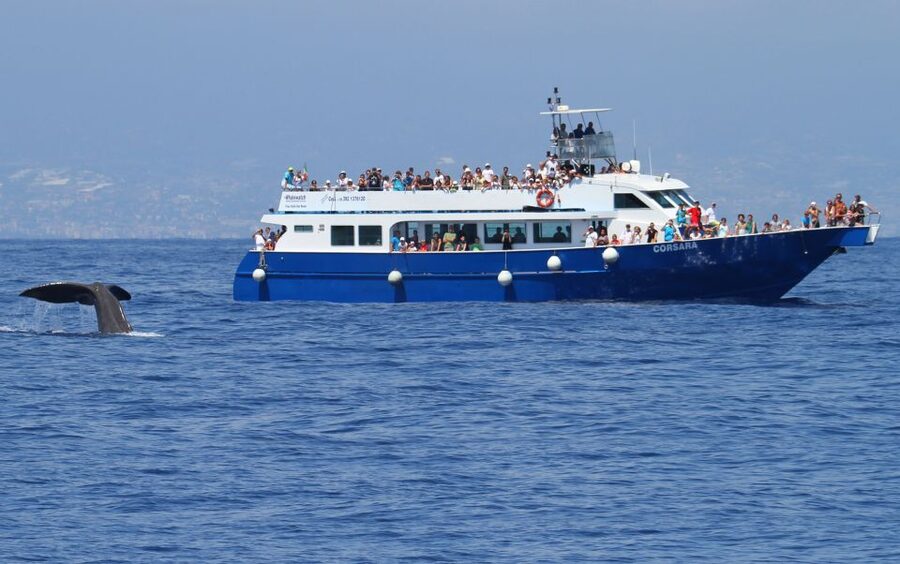
The crew scans the surface for signs such as a blow, a fin, a splash, or a group of birds gathering over activity below. When something is spotted, the boat may change course to get closer before the animal disappears from view. Several people who took the cruise described spotters watching through binoculars almost constantly.
The wait can be part of the experience, but it can also test your patience. One cruise took close to an hour before the first wildlife appeared. That is normal for this kind of outing, and the operator is clear that there are no set points or times for sightings.
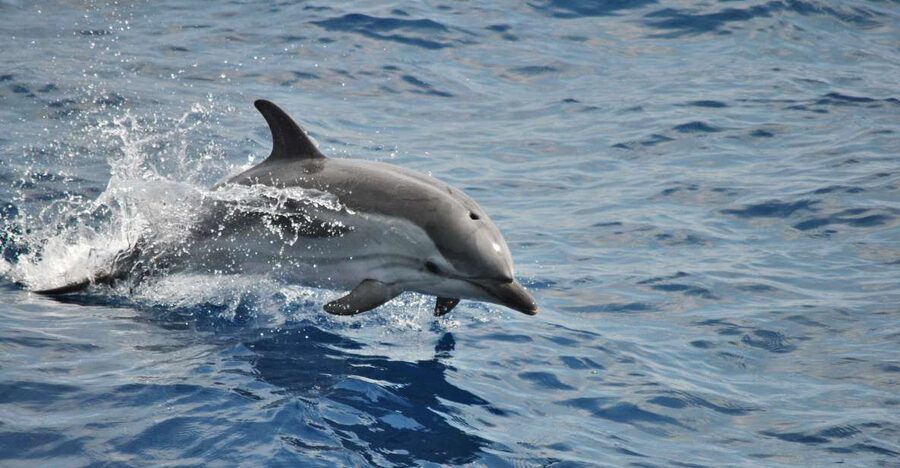
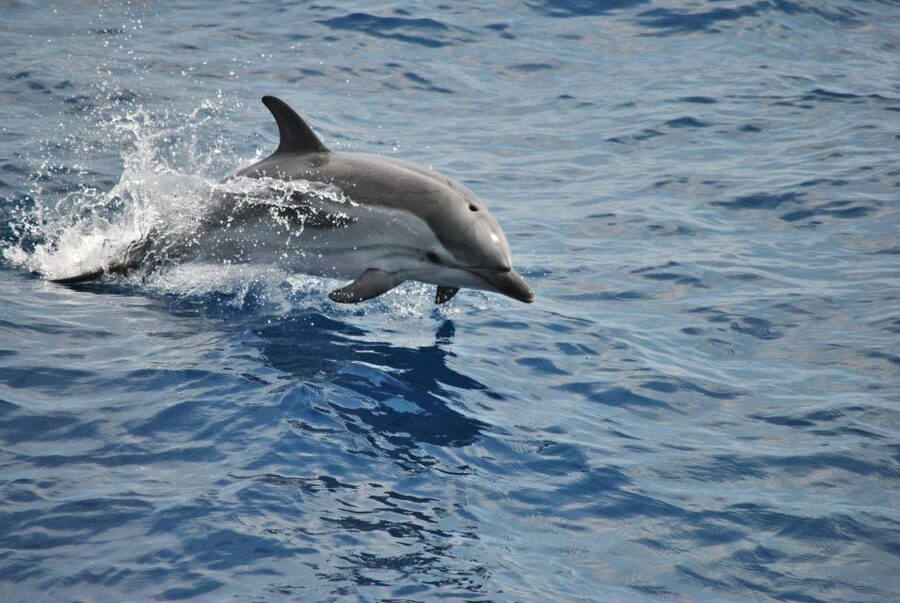
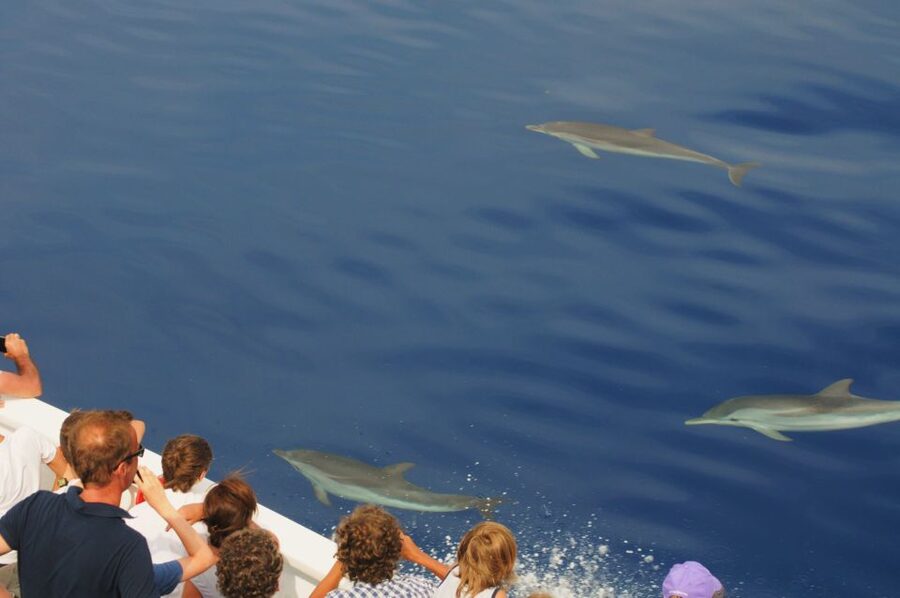
Once animals are found, the mood changes quickly. Dolphins may travel beside the boat, beneath it, or across its path. Large pods have included more than 25 dolphins, and several groups of striped dolphins have been seen on one trip. Dolphins can be easier to spot than whales because they often move in groups and surface repeatedly.
Whales require more patience. Sightings have included sperm whales, fin whales, minke whales, Cuvier’s beaked whales, and pilot whales. A few cruises have encountered mothers with calves, two whales together, or several sperm whales in one area. Those are special moments, but they are not the standard promise of the trip.
The cruise may also bring you close to loggerhead turtles, sea turtles, and seabirds. These encounters help fill the quieter periods and remind you that the sanctuary is home to more than whales and dolphins.
What the biologist adds
A biologist guides every excursion. That changes the tone from simple sightseeing to a basic field observation session. You learn about the animals’ habits, surface behavior, and the reasons the crew keeps distance instead of chasing them.
The guide also helps you understand what you are seeing. A distant back or brief splash can be hard to identify without context. A guide can explain why a whale surfaced only once, why the boat is waiting, or why a group of dolphins is moving in a particular direction.
English and Italian are listed as the main languages. A German or English-speaking guide may also be available if requested. Keep in mind that one family found English explanations difficult to follow at times, especially when information was being shared quickly in more than one language. If you want to ask detailed questions, stay near the guide when possible.
The crew’s attitude toward wildlife is one of the strongest points of the cruise. Captains have been described as avoiding aggressive pursuit, even when animals were nearby. That may mean a shorter viewing moment, but it is the right tradeoff for a wildlife trip. The goal is to observe animals without treating them like performers.
The animals you might see
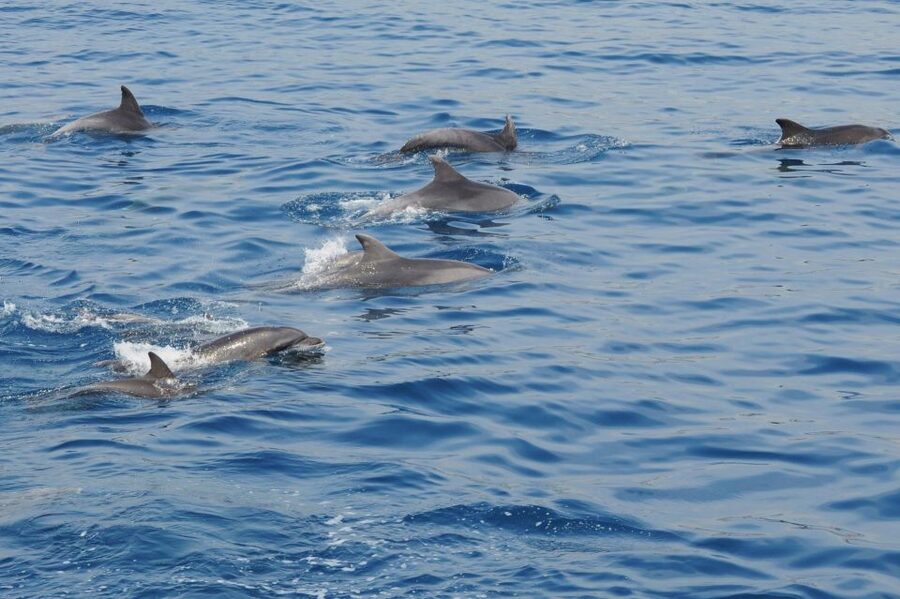
The sanctuary supports several kinds of cetaceans, and each sighting feels different.
Striped dolphins are among the more active encounters. They may travel in pods, race beside the boat, or pass underneath it. Mothers and calves have been seen together, which gives the guide a chance to explain group behavior and care.
Sperm whales are larger and less predictable. They may surface, show part of the back, breathe, and disappear again. Several cruises have seen one or more sperm whales, but you should expect longer waiting periods between appearances.
Cuvier’s beaked whales are especially difficult to find because they spend much of their time below the surface. Seeing several of them is unusual, and a guide may point out why the encounter is rare. Their appearance can be brief, so keep watching even when the sea seems empty.
Fin whales and minke whales may also appear. A fin whale is a major sighting, while a minke whale can be easier to miss because it may show only briefly.
Pilot whales are included among the possible sightings, though no particular species is guaranteed. Turtles and seabirds are welcome additions, especially on a day when whales stay out of view.
More whale trips worth the boat ride around the world:
- Tenerife: Eco-Yacht Whale and Dolphin Watching and Swimming
★ 4.7 · 15,619 reviews - Los Cristianos Respectful No-Chase Whale and Dolphin Safari
★ 4.6 · 12,782 reviews - From Funchal: Ecological Catamaran Dolphin Whale Watching
★ 4.5 · 8,204 reviews - Juneau Wildlife Whale Watching
★ 5.0 · 7,379 reviews
Choosing the right day and season
The excursion runs from April through October because the weather is usually more suitable during those months. Sightings can happen throughout the year, but the operator limits the season to make the trip more comfortable and practical.
The quieter months before the summer rush, especially April, May, and October, may offer an advantage because there is usually less shipping traffic. The schedule is narrower then, with trips on Sundays. From June through September, departures are on Wednesdays, Fridays, and Sundays.
Calm seas and little wind are the most useful conditions. Animals are easier to spot when the surface is smooth and their breathing marks the water clearly. Rough water can make the ride less comfortable and can hide small fins or distant blows.
You cannot control the weather, but you can choose carefully. Check the forecast before booking, and if you have flexible plans, favor a calm day over a windy one. The chance of wildlife is still never certain, but good sea conditions improve both visibility and comfort.
Comfort, timing, and the reality of open water
The cruise lasts about four hours, so this is a serious half-day activity rather than a quick harbor outing. You should be comfortable spending much of that time outside, looking across a wide stretch of sea.
The boat has toilets, and drinks are available for purchase. Seating and viewing conditions can vary, so you may need to move around to follow an animal. On a busy departure, getting a clear view may require patience. One passenger found the boat crowded, with less opportunity for direct conversation with the biologist.
The motion of the boat is another consideration. Even people who usually feel fine at sea may feel uncomfortable after extended periods of slow movement or waiting. If you are sensitive to seasickness, take your usual precautions before departure. The information provided does not promise medication or special onboard treatment, so plan ahead.
This trip is not suitable for people with mobility impairments. The operator also runs the excursion with a minimum number of passengers, so the departure does not depend on a large crowd.
Is $51 a fair price?
At around $51 per person, the price is reasonable for a four-hour cruise with a biologist guide and a trip into deep offshore water. You are paying for the boat, crew, fuel, search time, and expert interpretation, not simply for a short ride along the Genoa waterfront.
The value depends on what you expect. If you need a guaranteed whale encounter, no price will make this the right choice. If you understand that wildlife watching involves patience, the cost compares well with the length of the outing and the chance to see several species in one afternoon.
The free second excursion is an important safety net. If you see no wildlife of any kind, you can return within one year. You must contact the provider to arrange the additional booking, and the offer applies when there is no sighting at all, not simply when you hoped for a whale but saw dolphins and turtles.
That policy does not remove the uncertainty, but it makes the purchase feel fairer. A day with dolphins, turtles, and seabirds can still be worthwhile even without a whale. Several cruises have worked out that way.
Who will enjoy this cruise most
I would choose this outing if you like nature, open water, and the chance to see something rare. It suits families with older children who can wait quietly and follow safety instructions, as well as couples and solo visitors who want a break from city sightseeing.
It is also a good choice if you are staying in Genoa and want an activity that feels separate from the usual historic center and harbor circuit. The views from offshore are pleasant, but the wildlife search is the real reason to book.
You should think twice if you need a tightly timed activity. One cruise ran longer than expected, and that caused a passenger to miss a train. The crew helped with the next train in that case, but you should not schedule an important connection immediately after the tour.
This is also not ideal for anyone who dislikes boats, struggles with long periods of waiting, or has serious mobility limitations. The sea can be calm and peaceful, but it can also be repetitive while the crew searches.
Practical booking advice
Book a day with a favorable marine forecast if you have the choice. The provider allows free cancellation up to 24 hours before departure, and you can reserve now and pay later, which helps if the weather is uncertain.
Arrive at Calata Mandraccio with enough time to locate the boat near the Bigo and Coast Guard patrol boats. The listed departure is 1 p.m. Check the available date carefully because the schedule changes by season.
Keep your expectations realistic. A good trip may include only dolphins, turtles, and seabirds. A great one might bring striped dolphins, sperm whales, or the rare sight of Cuvier’s beaked whales. The crew will search hard, but no one can order wild animals to appear.
Should you book the Genoa whale-watching cruise?
Book it if you can give four hours to a patient search and you would value the experience even without a whale. The combination of deep water, biologist guidance, careful boat handling, and a possible second trip makes this one of Genoa’s better nature outings for the price.
Skip it if you need guaranteed sightings or have a tight train schedule. For everyone else, choose a calm day, allow extra time after the cruise, and treat the animals as a bonus rather than a promise. That mindset gives you the best chance of enjoying the sea, the views, and whatever surfaces.
FAQ
Where does the whale-watching cruise leave from?
The boat leaves from Calata Mandraccio in Genoa’s Porto Antico, near the Bigo and the patrol boats of the Genoa Coast Guard.
How long does the cruise last?
The excursion lasts about four hours. It leaves Genoa at 1 p.m.
What animals could I see?
Possible sightings include dolphins, striped dolphins, sperm whales, pilot whales, fin whales, minke whales, Cuvier’s beaked whales, turtles, and seabirds. No particular animal is guaranteed.
What languages are available?
The main languages are English and Italian. A German or English-speaking guide may be available if requested.
What happens if no animals are seen?
If there is no sighting of any kind, you can return for one additional excursion free of charge within one year of the original trip. Contact the provider to arrange it.
Is the cruise suitable for people with mobility impairments?
No. The activity is not suitable for people with mobility impairments.
Newly added whale trips around the world
- Vancouver Whale Watching Safari★ 4.6 · 45 reviews
- Victoria, BC: 3-Hour Ultimate Whale & Marine Wildlife Tour★ 4.6 · 191 reviews
- Vancouver: Day Trip to Victoria Seaplane with Whale Watching★ 4.5 · 109 reviews
- Vancouver: Open-air Whale Watching Tour, Granville Island★ 4.9 · 51 reviews
- Victoria: Whale Watching Adventure in a Zodiac Boat★ 4.5 · 129 reviews
- Vancouver Island: People Water Land – Indigenous & Whales★ 4.6 · 8 reviews
- Vancouver Island: Whale Watching Tour★ 3.3 · 2 reviews
- Vancouver: Zodiac Whale Watching Tour from Granville Island★ 4.6 · 6 reviews
Whale Watching Cruises, side by side.

Whale & Dolphin Eco-Cruise with Snacks & Drinks
Read our review →
Dolphin & Whale Watching Cruise with Swim Stop
Read our review →
Dolphin & Whale Watching Cruise, Drinks & Swim
Read our review →
City Cruises Boston Whale Watching Cruise by High-Speed Boat
Read our review →Lists this trip appears in